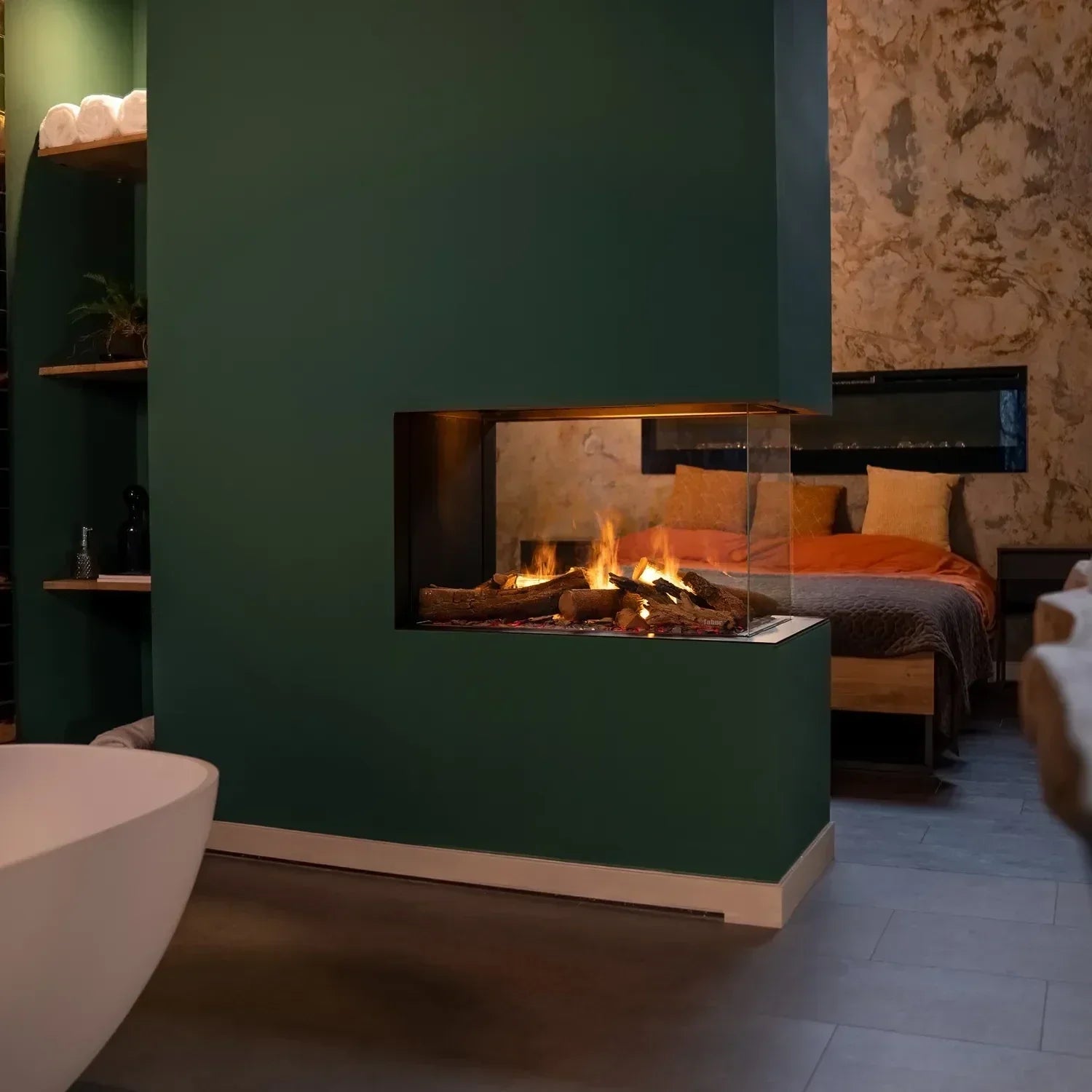

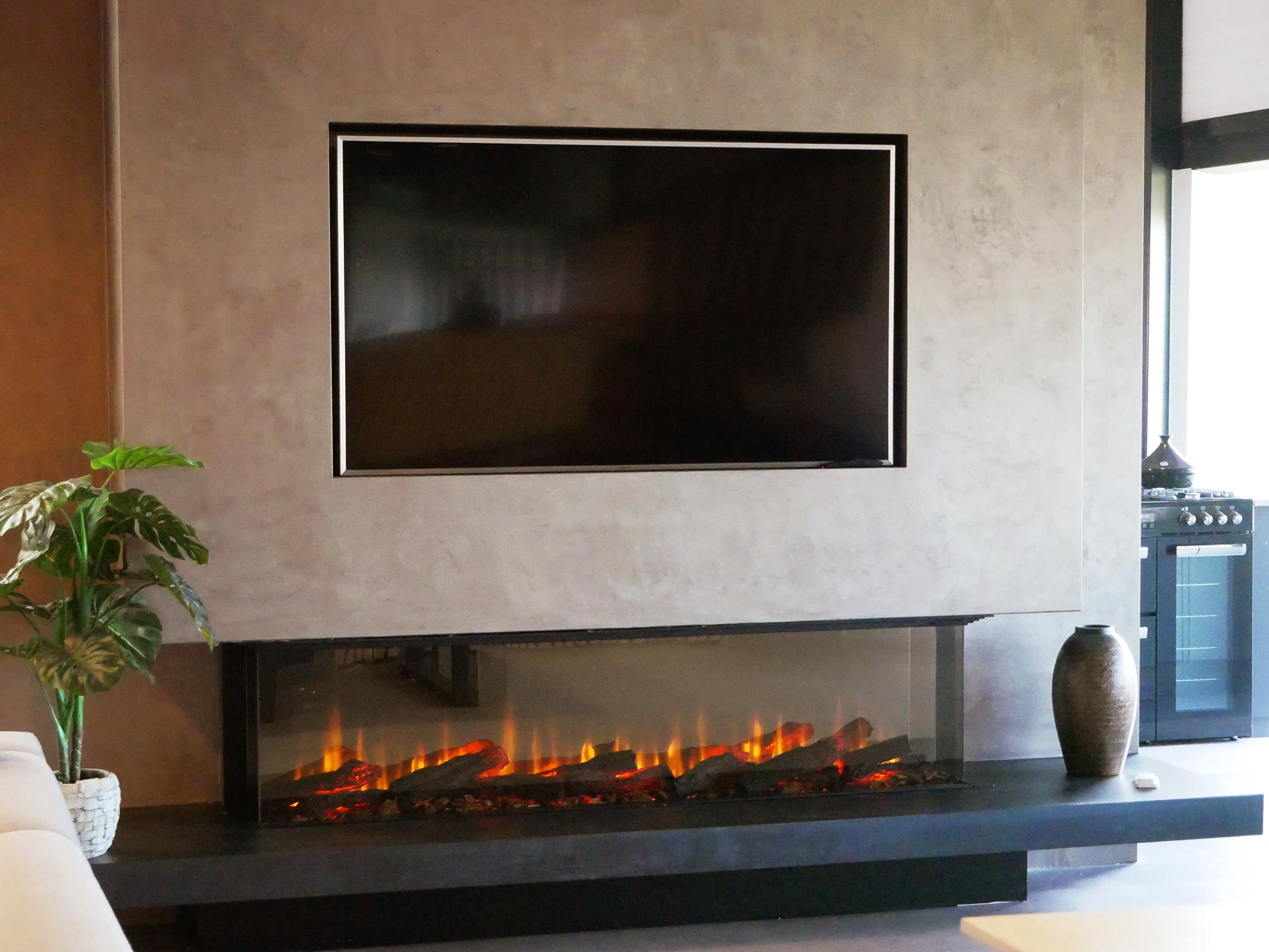
Two questions come up more than any others about electric fireplaces: how much warmth will it actually give out, and what will it cost me to run. They are really the same question from two directions, because the heat output determines the consumption. This guide covers both.
How Much Heat Does an Electric Fireplace Give Out?
Most electric fireplaces produce between 1kW and 2kW of heat, with some larger models reaching around 3kW. Nearly all offer at least two settings, so you can run at full output or roughly half.
Most models work by passing air over a heating element and blowing it into the room with a fan, which warms the space quickly. Some use radiant elements instead, which heat objects and people directly rather than the air.
Heat and flame work independently. Every model we sell lets you run the flame effect with the heater switched off. This is how most owners use their fireplace for the majority of the year, and it is also the single biggest factor in what it costs you.
What Affects How Warm the Room Gets
Two identical fireplaces in two different rooms will not feel the same, and the difference is usually the room rather than the appliance.
- Insulation. A well-insulated modern room holds onto heat; an older, draughtier one loses it as fast as the fire supplies it.
- Ceiling height. Sizing rules are based on floor area, but the fire has to warm a volume. High ceilings need noticeably more output.
- Glazing. Large windows and patio doors lose a lot of heat, particularly if they are single glazed.
- Draughts. An open chimney, an ill-fitting door or an unsealed letterbox will undo a lot of what the fire is doing.
- Climate. The same fireplace has a very different job in a mild winter than in a cold one.
- Open-plan layouts. If the room opens into a hallway or another space, the warm air will spread further than the floor area suggests.
This is why no guide can tell you exactly how warm your room will be. What a sizing figure gives you is a sensible starting point, which you then adjust up if several of the factors above apply to you.
Supplementary Heat, Not a Central Heating Replacement
An electric fireplace is designed to warm the room it sits in. It is not built to heat a whole house, and using one that way is both ineffective and expensive.
Used as intended, it is a good complement to an existing system. It takes the chill off a living room in the evening without firing up the central heating for the entire property, and it pairs well with underfloor heating, which is slow to respond, by providing quick warmth on demand.
What Does It Cost to Run?
The calculation is simple once you know two numbers.
Power (kW) x hours used x your electricity rate = cost
A 2kW fire running for 3 hours uses 6 kWh. Multiply that by whatever you pay per kWh and you have your answer.
Your electricity rate is printed on your bill, usually as a price per kWh. That single number is what makes running costs vary so much between households and between countries, which is why no guide can give a figure that is accurate for everyone.
What Each Setting Actually Draws
Because the flame effect is LED lighting, it costs very little to run. The heater is where nearly all the consumption sits.
| Setting | Typical draw | Energy used per hour |
|---|---|---|
| Flame effect only | Well under 0.1 kW | Comparable to a few LED bulbs |
| Heater on low | Around 1 kW | 1 kWh |
| Heater on high | Around 2 kW | 2 kWh |
Check the rating plate or specification for your own model, as outputs vary. The pattern holds regardless: the flame on its own costs a small fraction of the heater, and the low setting costs roughly half the high setting.
Working Out Your Own Cost
| Usage | Energy used |
|---|---|
| 1 kW for 4 hours | 4 kWh |
| 1.5 kW for 4 hours | 6 kWh |
| 2 kW for 4 hours | 8 kWh |
| 2 kW for 4 hours, 5 evenings a week, across 3 winter months | Around 480 kWh |
That last row is worth pausing on, because an hourly figure always sounds small and a seasonal total is what actually turns up on your bill.
Efficiency and What It Really Means
An electric heating element converts essentially all the electricity it draws into heat in the room. There is no flue, so nothing is lost up a chimney.
It is worth being precise about what that does and does not tell you. It means the appliance wastes nothing. It does not mean electricity is the cheapest way to heat a room, because that depends on what a unit of electricity costs where you live compared with a unit of gas. In many countries electricity costs considerably more per kWh. Compare the two rates on your own bill before assuming a swap will save money on heating alone.
Why Zone Heating Changes the Sum
Where an electric fireplace genuinely saves money is by letting you avoid heating rooms nobody is in.
Zone heating means warming only the space you are actually using. Turning the central heating down and running the fire in the living room for an evening can work out cheaper than heating the whole house to the same comfort level, even though electricity costs more per unit. The saving comes from heating less space, not from the appliance being cheaper to run.
How well this works depends on your home. It suits a well-insulated room where you spend long evenings in one place. It works less well in an old, draughty house, or if you end up running the fire and the central heating together.
Four Ways to Keep the Cost Down
- Use flame-only mode outside the coldest months. The single biggest saving available, and most people underuse it.
- Choose a model with a thermostat. The element cycles off once the room reaches temperature instead of running continuously, which can cut consumption substantially over an evening.
- Use the low setting first. A room that is already warm rarely needs full output to stay warm.
- Turn the central heating down when the fire is on. Running both at once removes the entire benefit of zone heating.
If you are unsure which output suits your room, get in touch and we will talk it through with you.